FIRE Movement in India: Financial Independence and Early Retirement
The FIRE movement, short for Financial Independence, Retire Early, is a financial approach focused on saving and investing enough money to gain greater financial freedom and potentially stop depending on employment income at a relatively young age.
The idea has gained attention among people who want more control over their time, careers and lifestyle. In India, FIRE planning needs to consider factors such as inflation, healthcare costs, family responsibilities, taxes, housing expenses and the long period for which retirement savings may need to last.
SEBI’s 2025 Investor Survey shows that achieving financial independence is already an investment goal for some Indian households, while retirement planning and generating passive income also feature among investors’ financial objectives.
What Is the FIRE Movement?
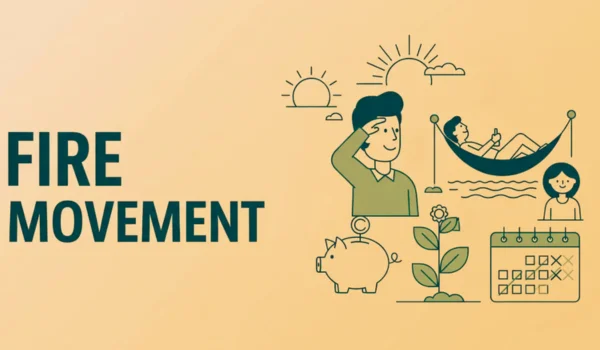
FIRE stands for:
- Financial Independence – having sufficient financial resources to support your lifestyle without depending entirely on active employment income.
- Retire Early – having the financial flexibility to leave full-time employment earlier than the traditional retirement age.
FIRE does not necessarily mean never working again. Some people who reach financial independence continue working because they enjoy their profession, while others switch to part-time work, consulting, business or other activities.
The central idea is to make financial independence a deliberate long-term goal.
How Does FIRE Work?
The basic FIRE strategy involves four major steps:
Earn → Save More → Invest → Build a Sufficient Corpus
A person first tries to increase income and control unnecessary expenses. The surplus is then invested for long-term growth.
Over time, the objective is to build an investment corpus that can potentially support future expenses.
For example, someone earning ₹1,00,000 per month and spending ₹70,000 has ₹30,000 available for saving and investing. If income increases while expenses remain controlled, the investment amount can increase further.
The exact amount required depends on future expenses, inflation, investment returns, taxes and the length of retirement.
FIRE vs Traditional Retirement
| Factor | FIRE Approach | Traditional Retirement |
| Retirement age | Potentially much earlier | Usually later |
| Main focus | High savings and investment | Long-term retirement planning |
| Income | Focus on building financial assets | Employment income until retirement |
| Lifestyle | Often controlled during accumulation | May remain closer to current lifestyle |
| Investment period | Starts early and may be intensive | Usually spread over longer working years |
| Goal | Financial independence and flexibility | Financial security after working life |
FIRE is therefore not simply about retiring early. It is about accumulating enough financial resources to gain greater independence from employment income.
- Calculate Your Annual Expenses
The first practical step is to understand how much you actually spend.
Track expenses such as:
- Housing
- Food
- Transportation
- Utilities
- Insurance
- Healthcare
- Education
- Entertainment
- Travel
- EMIs
- Family support
Separate essential expenses from discretionary spending.
For example, if your annual household expenses are ₹6 lakh today, your future FIRE corpus cannot simply be calculated by multiplying ₹6 lakh by a fixed number. Future expenses may be substantially higher because of inflation.
SEBI’s retirement-planning guidance recommends planning for retirement expenses, healthcare and emergency needs and reviewing the plan regularly.
- Calculate Your FIRE Number
Your FIRE number is the investment corpus you believe may be required to support your future lifestyle.
A simplified approach is:
FIRE Corpus = Annual Retirement Expenses ÷ Withdrawal Rate
For example, if annual expenses are ₹6 lakh and you use a hypothetical 3% withdrawal rate:
₹6,00,000 ÷ 0.03 = ₹2 crore
This is only an illustration, not a guaranteed or universally appropriate formula.
A withdrawal rate should be considered carefully because someone retiring at 40 may need their portfolio to support them for several decades. Market volatility, inflation, taxation and changing expenses can all affect the sustainability of withdrawals.
- Understand the Impact of Inflation
Inflation is one of the biggest challenges for early retirement.
Suppose your current annual expenses are ₹6 lakh. If expenses increase over time, the amount required after 15 or 20 years will be much higher.
Therefore, FIRE calculations should use future expenses, not simply today’s expenses.
Healthcare can be particularly important because medical costs and insurance requirements may change significantly during a long retirement.
- Increase Your Savings Rate
The savings rate is an important FIRE metric.
It can be calculated as:
Savings Rate = Amount Saved ÷ Take-Home Income × 100
For example:
- Monthly income: ₹1,50,000
- Monthly savings/investment: ₹60,000
Savings rate:
₹60,000 ÷ ₹1,50,000 × 100 = 40%
A higher savings rate can potentially shorten the time required to build the investment corpus, provided the strategy remains sustainable.
However, pursuing an extremely high savings rate by sacrificing essential needs may not be suitable for everyone.
- Increase Your Income
FIRE is not only about cutting expenses.
Increasing income can make the journey more flexible.
Possible approaches include:
- Improving professional skills
- Changing jobs
- Negotiating compensation
- Freelancing
- Consulting
- Starting a business
- Building a side income
- Creating digital products
For example, if someone increases monthly income from ₹1 lakh to ₹1.5 lakh while keeping expenses relatively stable, the amount available for investment can increase substantially.
- Invest for the Long Term
Savings alone may not be sufficient to achieve an early-retirement goal. FIRE generally requires long-term investing.
Depending on individual circumstances, investments can include:
- Equity
- Mutual funds
- Bonds
- Fixed-income products
- Government securities
- Fixed deposits
- Gold
- Pension products
- Other regulated investments
The appropriate asset allocation depends on financial goals, time horizon, risk capacity and other personal factors. SEBI’s investor education material emphasises matching investments with financial goals and considering risk while selecting investments.
Market-linked investments can lose value, so FIRE planning should not assume a fixed annual return.
- Create an Emergency Fund
Early retirement becomes difficult to maintain if every unexpected expense requires selling long-term investments.
An emergency fund can help cover situations such as:
- Temporary loss of income
- Major repairs
- Medical expenses
- Family emergencies
- Other unexpected costs
The appropriate reserve depends on income stability, household responsibilities and expenses.
- Plan for Healthcare
Healthcare is particularly important in FIRE planning because early retirement can potentially last several decades.
Consider:
- Health insurance
- Medical emergency reserves
- Family healthcare needs
- Future insurance premiums
- Out-of-pocket medical expenses
SEBI’s retirement-planning material specifically highlights the importance of planning for medical expenditure and emergency needs after retirement.
- Consider Different Types of FIRE
The FIRE movement includes different approaches.
Lean FIRE
Focuses on achieving financial independence with a relatively low-cost lifestyle.
Fat FIRE
Targets financial independence while maintaining a comparatively higher level of spending.
Coast FIRE
The person has accumulated enough investments early that they may be able to reduce aggressive saving and allow the portfolio to grow toward a future retirement target.
Barista FIRE
The person achieves partial financial independence and uses part-time work or another income source to cover some ongoing expenses.
These are informal FIRE concepts rather than official financial classifications.
FIRE in India: Important Challenges
Indian FIRE planning can be different from planning in countries with different healthcare, taxation and social-security systems.
Important considerations include:
- Supporting parents or other family members
- Children’s education
- Marriage-related expenses
- Housing costs
- Healthcare
- Inflation
- Taxes
- Longevity
- Changing family responsibilities
- Market volatility
SEBI’s 2025 Investor Survey found that Indian households often prioritise family-related financial goals such as children’s education and supporting family members, alongside wealth creation and financial independence.
This means an Indian FIRE plan should account for household responsibilities rather than focusing only on an individual’s personal expenses.
Common FIRE Mistakes
Avoid these mistakes:
- Assuming a fixed investment return forever
- Ignoring inflation
- Underestimating healthcare costs
- Using today’s expenses without adjusting for the future
- Taking excessive investment risk
- Ignoring taxes
- Having no emergency fund
- Planning retirement without considering family responsibilities
- Retiring solely because a target number has been reached
- Assuming investment income will always remain stable
Frequently Asked Questions
How much money is needed for FIRE in India?
There is no universal FIRE number. It depends on annual expenses, expected inflation, investment portfolio, taxes, healthcare costs and the number of years the corpus needs to support you.
Can a middle-class person achieve FIRE?
Potentially, but the timeline and required savings rate depend on income, expenses, family responsibilities and investment returns.
Is FIRE the same as early retirement?
Not exactly. Financial independence means having sufficient financial resources to reduce dependence on active income. Early retirement is one possible use of that financial independence.
Is the 4% rule suitable for India?
The 4% rule is a commonly discussed retirement-planning concept, but it should not be treated as a guaranteed withdrawal rate for Indian investors. Differences in inflation, taxes, asset returns and retirement duration mean that withdrawal planning needs individual assessment.
Should I stop working after reaching FIRE?
Not necessarily. Financial independence can provide the flexibility to choose whether to continue full-time work, switch careers, start a business or work part-time.
Conclusion
The FIRE movement in India is about building enough financial resources to gain greater control over your time and employment choices. The process generally involves increasing income, controlling expenses, maintaining a high but sustainable savings rate and investing for the long term.
A realistic FIRE plan should account for inflation, healthcare, taxes, market risk and family responsibilities. Rather than focusing only on retiring as early as possible, the broader objective can be to build financial security and greater freedom of choice.